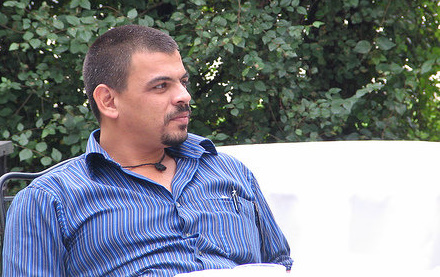
When I was writing about right to repair, FOSS and open content over at KnowProSE.com today I almost started with a more personal perspective than RMS in the MIT AI Lab. It’s a good enough story I think, but it lacks the AI loop back. It also tends to tell people more about me, and I didn’t necessarily want to be the focus.
Back when I was 9, I moved to Trinidad and Tobago and the first year or so I stayed in my grandmother’s house, in front of the Rampersad’s General Electrical Engineering workshop. There was an amazing assortment of stuff laying about, and being curious and as unsupervised as I could get away with, I would fiddle about. I made my way into the workshop as my father decided I needed more supervision, and since he was working in the workshop, it was easier for him to keep an eye on him. Plus, the guys would help him supervise me though they were much more tolerant.
The core business revolved around repairing motors. Established formally in 1936 by my grandfather, it was an important part of much of the infrastructure of Trinidad and Tobago and even the United States Navy, which then had a Naval Base in Chaguramas. He had started off by transporting motors on his old Indian motorcycle to rewind them himself at home, and ended up teaching others because he needed help.

Over time, I began understanding the how of the repair, but what escaped me at that age was the theory of why. I eventually got the hang of it, but I was not as good as my father, and if you asked him, he was not as good as his. That was high praise to me because I had seen my father walk in and simply listen to a motor and diagnose it at a client site.
Much of the rewinding was done by reverse engineering – a monotonous task of counting windings when taking the old ones out, measuring things, and so each motor had it’s own book and was stamped once rewound so that it could be referred to. It was a lot cheaper than buying a new motor in a developing country in most instances, and if they needed a new motor, we had those too.
It wasn’t a bad way to grow up. I got exposure to electromechanical troubleshooting at a young age. Sometimes it was the motor, sometimes the cause was around the motor: lack of maintenance was a big issue, lack of vibration dampening another, and sometimes it was the load on the motor that increased. Sometimes it was simply the quality of electricity that the State owned electric company (T&TEC) provided. Sometimes a motor sat too long and the bearings needed changing.
I left, I did other stuff, I came back, and I almost always ended up dealing with the workshop in some way. In time I ended up being a Director, but the business was being closed soon after because the inertia of the local market could not be defeated by the company. I was sad to see it closed, and with the family issues involved, I distanced myself.
In time, Chinese motors started popping up and could not be rewound because they used plastic armatures. Because they were cheaper than rewinding a motor, people bought them. This didn’t help the business at all – it worked against it. Effectively, the Chinese manufacturing had eliminated the right to repair by making the armatures that way. In time, though, people wanted their motors repaired and found out that they couldn’t be repaired.
For at least a decade, I had people calling me about motor repairs, and I’d put them on to some of the former employees who had started their own businesses. The core of their business tended toward electrician work, but some of them continued rewinding – and some of them I knew since I was 9, getting in trouble around the workshop.
The effective lack of right to repair and the inability to repair the newer imported motors practically killed a local industry, but it wasn’t a well-known industry. It still exists, though to a much smaller extent, and motors that can’t be rewound are probably stripped of their copper. Single use.
Things should be multiple use.
I also grew up with cobblers who fixed shoes, who are now almost extinct. In a developing nation, getting things to work longer is important, but when cheap shoes flooded the market, the same thing happened: cobblers began disappearing.
For small nations, those repair industries are needed much more. They help reduce the amount of foreign exchange spent, they employ people, and they allow a robustness when prices go up.
Prices always go up.