Starting 2026.

Sunshine

There’s plenty that could be waxed poetic about.
The global situation.
The near-local tension between Venezuela and the United States.
The AI slop coating the internet.
RAM shortages because billionaires are having digital wet dreams.

I rolled my eyes while writing that.

The world is already a landfill of the garbage we produce, and civilization inherits it—directly or indirectly.

Instead, I’ll just give a small update on my life, for those interested.

Continue reading

The Morality of Process, the Probability of Outcome

A glowing human asking a digital oracle for guidance

There is a tendency in modern discourse to force everything into binaries. Right or wrong. Good or evil. Us or them. These binaries create the illusion of clarity, but what they often do is reduce the complexity of life into digestible, weaponized arguments disguised as morality.

The truth is rarely that simple, if ever.

I often find myself straddling different ways of thinking. I assign weight to values, to beliefs, to truths, and let them exist in tension. I live in a world of shades, not one of absolutes. This does not mean I lack conviction. It means I acknowledge that convictions are not universal.

What is true for me can coexist with what is true for someone else, even when those truths do not agree, once we don’t push our truths on each other. Generally speaking, too, where there is truth there is commonality, for there are many paths to the truth and many angles of it.

Take a contentious example. It can be true that killing a fetus is murder. It can also be true that a woman has the right to make decisions about her own body. These two ideas do not cancel each other out. They are not mutually exclusive. They can exist simultaneously, and the people involved can bear the weight of those truths without outsourcing judgment to others. Unless someone is the other parent, it is no one else’s business.

That kind of thinking does not come from moral relativism. It comes from moral complexity. From understanding that ethics do not have to be imposed to be valid.

When it comes to outcomes, though, I shift. I think in probabilities. I watch the way people respond not to process, but to results. I see how we are trained to care more about whether our team wins than how the game is played.

This is where many lose sight of integrity.

Probabilistic thinking allows me to ask what is likely, not what is certain. It helps me prepare for multiple outcomes without pretending I can control them. But what it does not do is excuse the method. The method still matters.

What I see more and more is this: People are no longer concerned with the process unless it affects them personally. They are more likely to cheer their team for cheating and winning than for losing with principles. They will rationalize the shortcut. They will defend it as strategy.

But process is character.

You cannot build a just world by violating the path that leads to it.

You cannot manufacture truth through deception and call it communication.

So while I allow for complex truths, and while I navigate outcomes through probability, I hold to this: The way something is done matters as much as what is done.

That is not idealism. That is survival with integrity.

And maybe that is the real lesson here. You do not have to impose your morality on others. But you do have to live by it if you expect to be an example of why it should be lived by.

Not because it guarantees the outcome.
But because it defines the person you are on the way there.

And that defines who you are when you arrive.

The journey defines the destination.

Share This Post For Wisdom.

A glowing human asking a digital oracle for guidance

Wisdom.

A society that only shares headlines doesn’t read articles. Congratulations. You’re not a member of that society.

If the only value you have is liking and sharing a post, then your value is determined by those that control you, those that want you to like and share things so that they may gain something from it. The Internet works best when we all bring something to it. For those of you actually out there and doing things, thank you.

We say that’s how we like to spend our time, but is it more like a last resort? Daydreaming is more fun. We have books on our shelves to read, or if not, we have books to find. We have a second per person per second, which stacks up pretty big in the billions. We should be decorating time somehow. That might be wisdom.

These days they say AI will help with that.

Spoiler alert: It won’t, not by present systems anyway.

Before AI, it was the IoT (Internet of Things), before the IoT it was the mobile phone, before the mobile phone it was the Internet, before the Internet was the PC Revolution, all promising us better lives. More productivity implying more personal time. It’s not a new thing to say.

Interfacing with a kludgy digital ecosystem that others profit from doesn’t make us more human – it makes us less. It turns us into the batteries of the Matrix, fueling itself and not putting enough back.

Maybe we should be more than that. That might be wisdom.

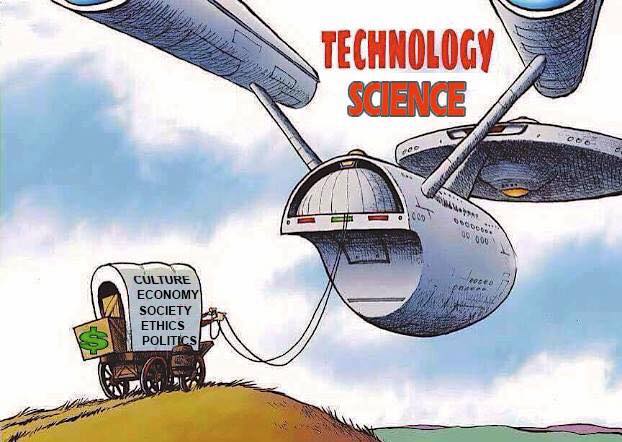
In An Age of Science and Technology…

Much of what I see these days is related to misunderstanding of science and technology.

Years ago, I noted when the automatic transmission was becoming popular, that an increasing number of people were unfamiliar with engine braking – the downshifting of a manual transmission to slow a vehicle. When engine braking, the brake lights don’t come on automatically, just like with an automatic transmission when you let off the gas to slow.

I can’t imagine how many vehicles that engine braked were rear-ended. So I started thinking about why. Why is it that people didn’t understand that other people with manual transmissions engine braked?

Then I helped people with cars, some older than I, and I was shocked to find that many didn’t know the basics of how a car functioned. Before the electronics took over engine control, you just needed to know that an internal combustion engine required spark, air (oxygen) and fuel. If you lacked one of those, the car wouldn’t start – and even today, with all the electronics, that’s true.

I recall as I was getting out of the Navy helping a Navy Chief with an MR2, and I popped the hood (behind the cab) and he started talking about the black round thing. It was the carburetor, where fuel and air mixed, and when I told him that he dismissed it as knowledge he didn’t need despite his car not working. This troubled me. Why would someone dismiss knowledge?

Continue reading

A Median of Dystopia In A Society of Averages

We are stuck with technology when what we really want is just stuff that works.

One of the more powerful things about a society of averages is getting people to use their time to think about the things that you want them to think about1.

That’s pretty much what technosocial dominant social networks do. Those centralized networks that allegedly give people what they want because of what they wanted in the past. That’s kind of like giving you a bicycle for your birthday every year because you wanted one when you were 8.

When I started writing about the society built on averages, it’s easy to just make that about intelligence, but that would be wrong. It’s also about what people think is important and how they think about it. To influence that is amazingly easy if you own a social network.

We have what has happened to Twitter since being bought by a serial… something or the other. We have TruthSocial, and His Donaldness The First, Winner Of His Own Golf Tournament. Isn’t it peculiar how those two people are now pretty much running the United States?

Maybe it’s just a coincidence. Or maybe by influencing what people think about and how they think about it, you can have a bigly effect.

Conditioning

Yesterday, before a medical appointment and later a friend, the electricity went away for a few minutes. Sitting at my desk, I felt a surge of adrenaline. My mind wanted me to do something, largely because generally speaking no one does anything where I live in Victoria Keyes other than complain about this or that or the other.

Over the years I had hopped into action, assessing the issue and communicating with everyone on WhatsApp, but since leaving the Board last week I have also left those chats. People, as they say, would have to paddle their own canoes. After all, recent events have me looking at my own well-being. I’ve done my part, from handling and communicating during issues to just putting up with some very self-centered griping from residents.

A Society Built On Averages

Title image for "Uncommon Talents: Gifted children, Prodigies and Savants" from 1998, Scientific American, by Ellen Winner

At the turn of the millennium, I read something that made so much sense to me that I built a bit of a world view on it.

At the time, my life was in upheaval as I chased this software engineering job and that, and I didn’t have time to flesh it out for others to understand. I couldn’t even remember what the article was, so when I did have time, I couldn’t refer back to it. Recently, after the heart attack and dealing with the bureaucracy of getting a triple bypass (no joy yet) I subscribed again and dived into the Scientific American archives. I found it.

The article is found in Scientific American1 Special Edition – 1998 Volume 09, No 4 – “Exploring Intelligence” – it’s written by Ellen Winner, and is titled “Uncommon Talents: Gifted Children, Prodigies and Savants”.

One of the interesting things raised by the article was – is – that society is not designed for outliers. In the great bell curve of society, society is designed for the majority– which is around the median.

There’s a world out there.

There’s a world out there.

I’m not writing about the world we all agree to, the things we take for granted and don’t question, even down to social graces and traditions.

There’s a world out there beyond what you see, what I see, what we all see. If you have a moment, it’s thoroughly interesting.

Our minds have this way of taking shortcuts. It’s the way we have managed to survive dangerous creatures and even social situations. Being afraid of snakes, spiders, heights, etc. – those are survival traits. If you’re not afraid of them you better be good at killing them quickly, using that adrenaline to fight instead of run. Survival of surviving a battle with a dangerous creature is likely not as high as running away, in general.

Beyond our reflexive responses lays a level of interaction that allows us to change the responses. I was afraid of snakes, so I raised some and got to know them and also myself just a little bit better. Spiders I wasn’t afraid of, but heights, sure. So I jumped off of things, out of things, etc. When you understand how much time you feel you have on the way down, you’re free of everything for a relatively short time.

If the reality we see is real, when it gets challenged it shouldn’t change. So what shaped the reality? What you shove into your sensors and brain, or what was shoved in. We who would deign to train AIs to be better than us are as flawed as our sense of reality, and that sense is so fragile that when others don’t share our sense of reality we discard them rather than explore them. We may even mock them, all the while wondering how dumb the other person is to not see things the way we do. Or how their personality is flawed. Or how they’re too ‘woke’ or ‘unwoke’.

To be fair, that last one seems fair criticism both ways most of the time. I identify as a social critic. Bite me.

When we have polarized disagreements, nothing good happens. Being ‘right’ doesn’t change things, it just makes you look like you have the power of foresight. Understanding why other people think they are ‘right’ is key to us understanding ourselves and coming to a reality we can all agree on. It is easy to write but almost impossible to happen.

Instead, people shout at each other because of the mob around them that gives them comfort and the illusion of safety. It becomes about dominance, and when it’s a battle for dominance expect blood. The world we have built, this reality, doesn’t tolerate the perception of weakness. It’s as unforgiving as we are, which is no mistake. That is, for better or worse, who we are. At least now.

It doesn’t have to be who we are, but we collectively chose this way for quite some time. Most of it probably started long ago, before the different religions that showed up all claiming that they were all right. We created Gods who are as vengeful as we are, largely written by men who decided that writing and dressing funny was more important than pleasurable procreation. Those guys had to be miserable. And because they were miserable, they made other guys like them copy them.

They had good days though, taking poetic license with what could be encapsulated in a 5 word sentence: “Be nice to each other.” On the bad days things were smitten, burned, or otherwise destroyed. On the good days, seas were parted. On the bad days, there were floods. I could do other references, but those are pretty well known across this human society – it’s woven into our reality, even if we’re not that religion. Few question it. Most go along with it. It’s easier that way. We like doing things that are easy. To defy a commonly agreed upon reality is a dangerous thing to do.

Thinking beyond the box is heresy to some, but the only box there is what some other people agreed to propagate. It’s the box agreed upon implicitly, unconsciously, and it does not always suit us well.

Bits of Me, Bits of You, Decaying to Nurture Society

I’m not afraid of much, when once I was afraid of many things. I tend to dive into my fears until they are fears no more. So I began interrogating myself about my fears a little more and found one. I don’t know what to call it.

It’s the bits of me that I share that I am most afraid of, not because they expose me but because I’m afraid of running out of bits. There are bits of me around the world, in little digital devices and held by people who I know and have known. There are bits of me here and there, flotsam and jetsam of my life given willingly, given unwillingly, and all the shades of willingly in between.

Surely this is a strange fear. The idea that the bits of us are finite could mean that we are born with a predetermined number of bits. That doesn’t make sense because as we grow and become embedded into the world we as individuals live in, we change – hopefully for the better, sometimes for the worse as our base personality and the world generate friction and erode each other. The world generally wins in that, sandpapering our personality into something that fits.

Continue reading