Decreased Interest in Strategy Games: Why?

Games in general are powerful tools for humanity because just like any other version of play in the animal kingdom, there’s value. Kittens learn to hunt by sinking their razor sharp claws and teeth into things. It’s preparation.

Mankind isn’t too different. We try to make education ‘fun’ for the same reason, with very mixed results, but one thing is constant in humanity: Play, and as our technology has become more pervasive, games.

That’s why maybe it should be disturbing that a recent study shows that there is less interest in strategy games.

“…But across its 1.7 million surveys, Quantic Foundry found that two thirds of strategy fans worldwide (except China, where gamers “have a very different gaming motivation profile”) have lost interest in this element of video games. “67% of gamers today care less about strategic thinking and planning when playing games than the average gamer back in June 2015,” the report reads.

When we looked for long-term trends across the 12 motivations, we found that many motivations were stable or experienced minor deviations over the past nine years,” Quantic Foundry said. “Strategy was the clear exception; it had substantially declined over the past nine years and the magnitude of this change was more than twice the size of the next largest change…”

Gamers Are Becoming Less Interested in Games With Deep Strategy, Study Finds“, Ryan Dinsdale, May 22nd, 2024.

That China has ‘a very different gaming motivation profile’ is interesting. The postulation presented in the article is that social media may be ‘wearing people out’, which is a fairly summarization that could related to the average attention span falling from 150 seconds to 47 seconds.

As Quantic Foundry’s post points out, it’s pretty easy to just blame social media and move on.

…the decline in Strategy is likely not an idiosyncratic phenomenon among digital gamers, but parallels the general reduction in attention spans observed by researchers in different fields.

But because all over-time comparisons are inherently correlational, it’s difficult to pin down cause and effect. While we often blame social media for our decreased attention spans, there’s a lack of concrete causal evidence for this. Of course, it bears pointing out that causal evidence for this would be difficult to produce since it’s unethical to raise children in artificial labs. Also, the shot duration analysis in movies is a counterpoint to blaming social media entirely: this downward trend in media attention span can be traced as far back as the 1930s, although it is certainly possible that social media accelerated the underlying trend.

Another potential hypothesis is that the increasing negativity, polarization, intrusiveness, and emotional manipulation in social media has created a persistent cognitive overload on the finite cognitive resources we have. Put simply, we may be too worn out by social media to think deeply about things. For example, higher engagement with social media is correlated with lower math and reading scores and poorer mental health among teenagers. Of course, again, these findings are correlational and not direct causal evidence…

Gamers Have Become Less Interested in Strategic Thinking and Planning“, Nick Yee, Quantic Foundry, May 21st, 2024.

Before Social Media.

Yet if we dig in through one of the links in Quantic’s article, we find this before social media. We find that shot durations in movies have also been dropping in length.

…Although pacing can refer to motion (Cutting, Brunick, DeLong, Iricinschi, and Candan 2011; Cutting, DeLong,and Brunick 2011) or to the rate of cross-cutting between narrative threads (Bordwell 2013),we will use the term referring to the duration of shots as they have become shorter over time (see also Pearlman 2009). Indeed, the averages shot duration in Hollywood movies has declined from a mean of about 12 seconds in the 1950s to a bit less than 4 seconds in the 2000s (Cutting, Brunick, Delong, Iricinschi, and Candan 2011; Salt 2006)…

Shot Durations, Shot Classes, and the Increased Pace of Popular Movies, James E. Cutting and Ayse Candan, Projections, Volume 9, Issue 2, Winter 2015

Interestingly, this same document has this:

…The second popular account for the shot-duration decline concerns a possible cyclical reciprocity between mass-media screen content and the attention patterns of viewers—sometimes described as a nearly ADHD (attention deficit hyperactivity disorder) affliction. The idea is that quickened screen
content (television programs, websites, and movies) alters our general attention patterns, perhaps shortening our attention span, and that the makers of this content must incrementally continue to quicken content to keep up with ever-shortening attentional capacity.

Although this idea promotes an incremental change like that seen in Figure 1, we know of no evidence in its support…

Shot Durations, Shot Classes, and the Increased Pace of Popular Movies, James E. Cutting and Ayse Candan, Projections, Volume 9, Issue 2, Winter 2015

Taken by itself, this would lend itself to a net effect of movies becoming shorter. In fact, movies have become longer, which would indicate that there are a lot more shots in a movie and density of content. There’s some more movie length statistics here.

While Attention Spans Might Be A Factor…

It could simply be the cost of doing a good strategy game. In essence, it may not be about the gamers, but about the gaming companies. Creating compelling strategy games is more difficult, and combined with a world that might have people simply wanting some less mentally taxing game to unwind with could be the crux of this. As someone who enjoys a good real time strategy game myself, I am not too interested in the offerings of the last few decades.

A good strategy game, too, generally outlives other genres and therefore doesn’t need to be replaced as soon. This means that it may not be as lucrative for a game company to release strategy games when it could be pumping out first person shooters.

And the other hypothesis Yee described, ‘increasing negativity, polarization, intrusiveness, and emotional manipulation in social media has created a persistent cognitive overload on the finite cognitive resources we have’, could also mean that in the fight for the time of people who would be interested in strategy games, social media might be more attractive.

Movies have gotten longer, attention spans have gotten shorter- but in the end, we only have 24 hours of temporal currency to spend every day, and every move technology makes to ‘make us more productive’ never quite gives us that extra time it promises.

There’s certainly a lot to think about here – if you have the time.

Cooperative Real Time Strategy.

Recently, I started playing Starcraft II again. It’s one of the best real time strategy (RTS) games available, aside from Homeworld and Homeworld II. I really wish Homeworld III would launch.

I’m on Battlenet as Taranis, and you can say ‘hi’ – but be warned: I’m an old guy playing a video game and I won’t say I’m competitive as much as competent. I don’t like the competitive side of the game that much. In more competitive modes, I prefer Free For Alls, but I really like the cooperative gaming because I’m not playing against other people, instead playing towards a common goal. And in cooperative mode, I almost always play Vorazun (pictured) – cloaked units with high damage, the ability to stop time every 4 minutes, and I just really like the sound of the dark templar slashing through things. I could go on.

It’s fun.

As we were discussing in chat today, there are some jerks in cooperative mode, but you can always block them. I’m not sure if that means you can’t play with them, but it certainly means you don’t have to listen to them.

It’s fun for me playing in cooperative mode. Some people are better than you, some aren’t, and sometimes you make a misstep, sometimes they do, and it’s not about who is the better player as much as filling in each other’s gaps and winning the objective. Sometimes you lose. Losing is a learning experience. Don’t lose your temper, raise your game.

Cooperating. There just aren’t enough games that let you do that. Even what I consider to be one of the best rts ever, Homeworld II, didn’t have that.

When I play a game, I don’t like to be around jerks. Most of the time I’m playing games it’s to escape from a world full of jerks. Why would I set myself up to deal with them while I’m supposed to be having fun?

We need more cooperative games against non-players, and AI has reached a point where we could be doing that. I think we should. We don’t need people practicing hating on each other and getting under each other’s skin – there’s plenty of that in the real world.

Who knows? With more cooperative games, maybe being a jerk won’t be seen as an asset in the real world as much.

Advocacy And Social Networks.

social media remote via animated heaven flickr user public domain 1 aug 2022
Via Animated Heaven on Flickr, public domain.

Having now seen the troubles with Facebook (and by extension all companies under Meta), and getting involved in Twitter, I’ve seen a few things that disturb me. While my political views would hardly be called popular, I have taken pretty strong stances in support of Ukraine and women’s rights, as examples. This, of course, means you end up dealing with people of like minds because that’s how the social networks work.

However, we humans tend to confuse people going in the same direction as those who are going to the same destination, and in that regard, there is trouble. I’ll deal with the issue of social media interactions and Ukraine here because after the horrid video of the torture and castration of a Ukrainian Defender made the rounds, followed by an execution – I saw the video, it was absolutely horrible – things are even more tense.

The blowing up of a Ukrainian PoW camp even as Russia tries to say it was Ukrainians who did it… well, the Geneva Convention has rules about how far from the front PoW camps are supposed to be, and Russia of course ignored that, and evidence is that Russia did it. The United Nations and International Red Cross were useless. Broken. It’s hard for anyone observing to not be upset at some level, but apologists remain.

Now, these social networks have their own little echo chambers, and there’s plenty of disinformation to go round.

Given the failures of the United Nations and International Red Cross, and given that Ukraine likely doesn’t have the time or resources to create a registry of NGOs that are actually helping, it’s a matter of finding out from the ground in very quiet ways. I have done so, and I’m very select in what I share in that regard.

While all of that is happening, we of course have the Russian propaganda and misinformation happening, and people are calling that out. Some of it is patently obvious, like the same serial number on a missile used twice in Russian propaganda. There are plentiful examples of that sort of thing, even using pictures of the United States in Russian propaganda. Meanwhile, a genocide is happening in Ukraine, and the world is worried about inflation.

The price of living up to ideals is discomfort. And if our ideals are not worth the discomfort, there’s not much space for ideals in the future. During World War II, my fathers’ side of the family was getting rations in Trinidad, while my mother’s side was busy in the military or Merchant Marines. We call it sacrifice, whose root is, ‘to make holy’, but it is the cost of our ideals and how we wish the world to be.

In all of this, the social media interactions I’ve observed have had me thinking I should write this.

Becoming What We Hate.

There’s some things I see that I generally stay away from. I’ve seen people who support Ukraine go through multiple accounts on Twitter, referring to ‘Russian cum guzzlers’ and other creative profanity, to just this morning watching a group call out someone on something they didn’t agree with, calling in their group, and bringing up the fact that this person had been accused of causing a suicide through orchestration of social media posts… not unlike what that group was doing to the person themselves.

Wait, what? Yes. Don’t become what you hate.

Whataboutism.

Then there’s the falsehood of whataboutism. Some trolls will bring up something like what has happened in Iraq, or Syria, trying to create a parallel and at the same time reinforcing a division. Rather than engage it and say, “Yeah, that is/was wrong too”, which would allow the casual observer who might think that there really is a bias rethink their perspective. Instead, dismissing it reinforces to the readers that that particular issue is not considered real, when it very well may be, reinforcing their beliefs which works against the actual advocacy someone is trying to do.

I’ve done this quite a bit, saying, “Yes, that is bad too.” It generally is, and when someone reads that, it at best doesn’t reinforce a bias that the reader may feel when they started reading. At worst, there’s no comeback to it. All it takes is considering beyond the current person and to the greater audience who may not be interacting but is reading.

Whataboutisms are landmines of unintended consequences that, handled improperly, can cause people you don’t even know about to harden their resolve against your cause. What’s worse is when there is even a small amount of legitimacy in them, because unanswered, they fester. You might enjoy that smug feeling, but if your intent was to change minds, you likely failed.

And if you are advocating, for whatever reason, and you don’t want to change minds, you’re not advocating.

The Pile On For Mistakes.

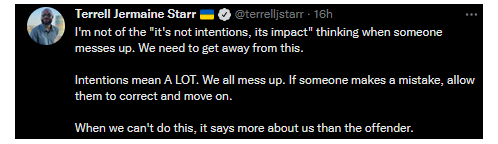
People pile on to others during disagreements at times when they’re assuming intentionality, or not even worried about the intentionality and only the impact. Someone said it well enough to quote, so here it is:
Terrence Jermain Starr Intention Impact
People make mistakes. I made a mistake early on in writing, “The Ukraine” rather than Ukraine, and someone understood my intentions were good and corrected me. I thanked them for the correction and never made the mistake again. I was fortunate in that regard, because there are people out there being pretty groupthinkish about what people should say at this point. However, we have to understand on a social network that people aren’t fed the same news we are, their lives are different, their world, as they see it, is different. This doesn’t mean that given facts they won’t change their minds, which is sometimes the case. But it gets nasty, and it can border on bullying.

We get to decide who we are on social media. We get to decide what we participate in or not. If it’s a Russian embassy putting out crap, I’m all for letting the pile ons happen – after all, someone is getting paid to post things that need to be called out. But if it’s someone who made a mistake, and we assume intentionality, we can actually ruin someone’s life.

This happened recently to someone I had interacted with in more than one Twitter space. I don’t know what happened, no one talked about it, but suddenly they just deleted their account after saying goodbye because they – who had supported Ukraine without question – was accused of spreading Russian propaganda. Another person I know who is well read on Russia and it’s history and who has helped me map out commonalities with European colonialism got accused of spreading Russian propaganda because they omitted something in something they wrote by someone in one of the popular groups on Twitter supporting Ukraine. I did something I don’t do often. I stepped in and was surprised I didn’t get a pile on out of it.

Today, something similar happened to myself, but it was sidestepped by a neutral party that I respect and it came to a halt. This group think policy is something that people should be considering when they become members of a group: What’s the destination? It’s not just about direction.

It’s not just about impact. Intentionality plays a part.

Groups Get People Looking for Fights.

As groups get larger, people join who just want to fight. The goal of advocacy is to win, not to fight. Fighting is necessary sometimes. Worse, you sometimes get people these days who pretend to be advocating for one thing when they’re really advocating for another, and without structure, these groups have no mechanism to deal with it.

Wrapping This Up

I could wax poetic about how to handle situations on social media and social networks because I have been involved in moderation since the 1990s in various ways, and I have been wrong, and I have been right. Being wrong and correcting my mistakes has allowed me to be right more and wrong less.

I’m imperfect. I get things wrong. I correct them when I find them.

The more technical side of this, which is imperative, can be found here: Why Social Media Moderation Fails. It deals with the black boxes of how social media platforms respond to things differently, and can appear to have biases that we ourselves can create. These social media platforms were hardly designed for the sorts of things that they do. They’ve been reactionary, imperfect, and sometimes they seem outright biased – but there’s no real evidence showing it. It’s our own bias, until we get evidence, and social media networks are hardly known for transparency. Oddly enough, it’s an iron curtain.

If you’re going to play these games on social networks and you don’t know the rules the social network uses (which is really most social networks), you could be shooting yourself in the foot and not even know it.

The trick to all of this, in any form of advocacy, is not that people are traveling in the same or even different directions. It’s about the destination, and the destination a person has is what they are advocating for. It’s also about not destroying one’s own advocacy.

Speaking for myself in the context of Ukraine, I would like to see Ukraine’s sovereignty honored by it’s inhumane neighbor. I’d love to see the International Criminal Court do it’s job. I’d like all the children forcibly moved by Russia to Russia returned to Ukraine. That is my destination.

And to be frank, that doesn’t seem like enough, but that’s more than enough right now.

Maintain

Warrior In The GardenIt is silent in the morning, aside from the gossip of the birds and the rustle of the wind through the trees and brush uncleared. The odd passing vehicle on the highway alternates between a diesel and a small gas powered vehicle.

Light peers over the horizon in the early morning, revealing the detritus people left at the boundaries – the two legged pests that generate rubbish faster than they can get it taken away – a constant battle on the perimeter not to be won in the near future, only to be dealt with. In the distance, the nearby houses and gardens, nearer, the vultures that roost in trees nearby whose roosts must be continuously disturbed so that they move elsewhere.

It’s a shame to disrupt this with the sound of a two stroke engine, but necessary – the whine of the blade as it spins through brush, clearing a path to clear a path, sometimes working the perimeter, sometimes working through brush that hides contours that can easily break an ankle or leg, sometimes clearing around the trees whose future depends on it.

Constant watchfulness, passively interrogating the wildlife nearby, always knowing where everything is, where it should be, recognizing things out of place – a stray footprint, tire mark, grass pushed the wrong way, clearings within spaces otherwise overgrown. Flycatchers pick out the insects left from the wrath of the spinning blade.

And it all falls behind – all becomes a part of the greater whole, and the mind is free to wander as all of this is watched. The matters of the day, the larger strategies, the small minds and the large problems pour out like the sweat of hard work. It is dangerous in this; it can be too attractive and draw from the present, so another part of the mind has to now keep an eye on the wandering mind so that while free it is safe and can be snatched to the present quickly. It watches the shadows, listens to the sounds, keeps track of tools… A passing driver waves, a wave back, a rustle in the trees or a snap, check 6.

Time passes, work is done, a break. The machine cools, and the morning returns to the natural sounds – more vehicles now. Maybe some bananas, definitely some water, and with better light a survey of what was done and what needs to be done.

And again. And again. And, maybe, again. Meditations, clear thought, hard work.

All one has is not what one can claim, but what one can maintain. Taking a hill means nothing when it is lost tomorrow, making a large profit means nothing when the money is spent immediately. True success in any endeavor is supposed to be a ratchet, locked so it cannot spin back – building on a foundation rather than constantly fighting one.

And that is coming.

Strategy and Sacrifice

Story time.

My father was teaching me chess back when I was a kid. About 9. He and my mother always played, and I suppose they thought it was time for me to learn. I had my ass handed to me, but I always got back to the chess board – and I was always playing, even alone I would play myself. The habit of playing against myself would stay with me for about a decade, and taught me much about seeing different perspectives at the same time.

My father taught me not to lose pieces because they were valuable. I saw that his strategy worked for him and that it didn’t work for me and, one day on the back patio of a 1970s suburban home in Ohio, I sacrificed my Queen. He shook his head, frowned at me in the way only a disappointed father could, and in 3 moves I had him in checkmate. I celebrated, having finally beaten the champion of the house.

Mahin Rampersad at Sam Young House (18-3-1967)

He would not play me again for 30 years. I would see later that in beating him I had created a divide. That’s him on the left in the picture.

I had sacrificed a part of the relationship with my father when I beat him that day – his identity was tied to winning at chess and his son, using a strategy that he didn’t want his son to use, had beaten him fairly. I would go on to play chess in the house with anyone and I would and typically win (we remember our successes and downplay our failures, I know that). The only person I really wanted to play with was the old man.

Sure. I was only 9 and I wasn’t the adult, and my father – like everyone else’s – was imperfect. I refuse to blame him, instead taking the lesson from it.

What I learned, though, was that to become good at something, or to achieve something you want, you have to sacrifice. I would later learn that what you want isn’t necessarily for you, that you can want something for someone else and make the same sacrifices.

Sometimes you protect the ones you care most about by sacrificing your own wants and needs. It might mean a white lie here and there. It might mean hiding your feelings for someone you care deeply about, knowing that showing them would make their situation worse.

We talk a lot about strategy and winning, but we don’t talk enough about deciding what we want to win, or deciding what is best for those around us. Taken too far, it can be selfish – robbing others of choices. Taken not far enough, it can also be selfish – adversely affecting things just so we get some short term gain.

In the end, we decide what we sacrifice – and sometimes we don’t and have unforeseen things crop up. That’s called life.

Sometimes we make tough decisions and hope for the best.