Of Bears And Men

I’m not sure where it came from, but this thing about a woman choosing between a bear and a man has been going across social media. At first, I laughed, because I completely understand why some women might choose a bear.

Given an opportunity to choose between a bear and a man, I might go with a bear myself. Given a choice between a bear and a woman, I might go with the bear too. It’s not a gender thing, it’s a people thing. People come with baggage.

I know what to expect from a bear. People are wonky. I thought the whole thing was a pretty good joke from a female perspective, but I’ve seen it take a turn for the serious – and sadly some men have made the point women make with the (hopefully) initial joke. If it wasn’t initially a joke, it was… unkind to the good men out there, and yeah, they do have a right to say something, just as a woman would have a right to say something if the underwear on the joke were of a different gender.

Yet as it plays out across the internet, various examples pop up in response to women that do a good job of demonstrating why a woman would make the choice of a bear – some demeaning and sexist stuff. That’s the stuff you see. The stuff you don’t see are the men who either know it’s a trap – because it is a trap – or know that even defending the good guys out there (there are some of us, I count myself among them) will cause other men to show up from the shadows to beat on them. Why? Well, because they want to be seen as good men, clearly. Good men, though, might be offended by the whole thing.

Maybe good men should be offended. If men made generalizations about women, all manner of fury would rain down on them, as some female influencers have pointed out.

Let’s change this up a bit. If a woman is walking down a dark alley and sees a black man and a white man, which does she choose? Suddenly we have profiling. This is why I say it’s a trap. A well baited trap, sure to cause some anger amongst both good and bad men.

As someone who has walked across streets in dark places so as not to alarm women – all 5’3″ of me, looking hispanic in the U.S. – I see both sides because I’m used to being hated for the wrong reasons.

Maybe there is a woman out there who answers – and I think properly – it depends on the man and the bear. Toxic masculinity is a thing. I understand that, and I think most men do just as well as women in very different contexts. Some men are jerks, just as some women are… less than perfect, let’s say.

Toxic femininity is a thing too, though I’m not well read on the topic and I don’t presently want to be. You can find it on search engines, and no, it’s not a bunch of guys talking about bad women. On cursory inspection, it looked much more deep than that and something maybe women should talk about too.

I find it convenient as an individual to lump people in general into toxic and non-toxic categories, but that too isn’t fair – it’s really about toxic relationships, and not always the romantic kind.

If you’d choose a bear over me, I’m good with that. I’d like some distance from the bear anyway. While bears might be more predictable, the stakes are higher, and I don’t feel like winning a Darwin award.

In the end, it’s easier to avoid women and bears, which is probably why I’m single and uneaten. I’m good with that. So much less drama.
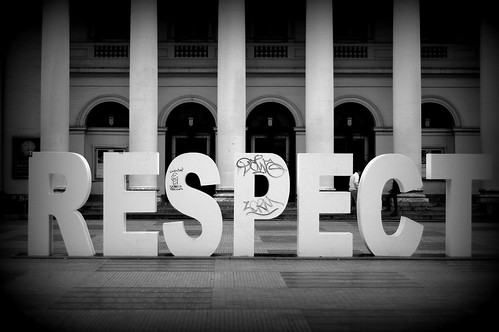
Respect, Trust

RespectWe know a few things about respect: it has to be earned and it’s hard to get back when lost. This parallels trust – trust and respect go hand in hand this way.

Can you trust someone you don’t respect? Can you respect someone you don’t trust? There is nuance in there beyond the black and white responses, the default ‘no’ we are taught as children.

We can trust someone we do not respect to do what is in their ‘nature’. In fact, some even expect it of them: A simple label can conjure up images of what such a person is or might do based on what they have done. That label and ‘trust’ is what builds out our negative prejudices (yes, there are good prejudices as well). Feminists often make the case that simply being a woman means that they are ‘trusted’ to be certain *things*, objectified in their own way. Black Live Matters makes a similar case about people of African descent (paying lip service to other minorities), Blue Lives Matter makes a similar case about police. We trust for better and worse that people will act in certain ways based on other things in common.

It should scare people slightly that this is how we write our software that analyzes data as well.

But there are good things about such stereotypes, too. We are more friendly with certain people, more comfortable around certain people where we blend in well. Those of lesser pallor will quite obviously feel more comfortable with those of their pallor, and those of greater pallor the same. People who wear jeans are more comfortable around those that wear jeans, those in suits feel more comfortable around people of business attire.

The problem isn’t respect as much as it is trust. It’s what we trust others to do that is the problem, our brains evolved for survival in a planet that we have become dominant over except in a few special cases.

So the next time you distrust someone – which is just trust in a different direction (for the nerds, it’s a vector instead of a scalar) – take a moment and allow that trust to change.

Or don’t and submit yourself to the status quo.

Labels, Labels, Labels

Vanabbe Museum - MuseumnachtCertain things irk me. One of these things which has become more rampant and divisive is the use of certain phrases that, if anyone actually read and understood Pedagogy of the Oppressed, they wouldn’t use.

There is power in words and this power can guide a conversation or end it – and these days, it’s apparent conversations are ending, be it with Brexit or the exuberant hatred of people who elected Donald Trump to the Presidency of the United States.

In essence, people are going to get angry with me. Vexed. Aggravated.

Let’s take on a few key phrases.

Equality.

Everyone talks about equality, but we all want to be better than others. How can I, on one hand, want people to be treated the same as myself without being willing to be treated as poorly as they are? How can I say that men and women are both equals? That is, at it’s core, odd – not because of the idea people are trying to convey, but because the appropriate word is ‘equitability‘, a word so foreign that my spell-checker need it added:

characterized by equity or fairness; just and right; fair; reasonable:
equitable treatment of all citizens.

We want people to be treated fairly. Treating people equally would mean treating them the same, which is silly. Just taking gender as an example, treating men and women the same when one does not become pregnant and another does leads to all sorts of silliness. But we could treat women with equitability. And then we can realize that what women and their allies are actually negotiating for is to be treated fairly. What’s really being negotiated is what fairly is.

We are all different, despite labels, and we cannot be treated equally because we’re not all good at math, we’re not all artists, and we’re not all brain surgeons or automotive mechanics. But we can be treated equitably.

Race

This drives me nuts as a multicultural. There are, scientifically, no races. There is absolutely no genetic evidence of ‘race’. This is a social construct, and when we discuss ‘race relations’, we’re having an argument that someone else dictated, by the rules someone else dictated, for their own reasons. And that ‘discussion’ is going exactly as designed, powered by people who are too interested in fighting and not interested in the objective: Equitability. Cue Morgan Freeman:

[youtube https://www.youtube.com/watch?v=Mh8mUia75k8]

‘Patriarchal Culture’

Patriarchy is easy enough, and may be seen as an apt descriptor only when discussing gender and sexual rights, and in doing so it is mislabeled more often than not because minority males suffer as well. There can be argument about whether, as an example, a white woman is treated better than a black man, etc. So is it really patriarchal culture, or is it an antiquated culture? Women had and continue to have power in what are called patriarchal systems and cultures. Is it equitable to nail this down all on every man that draws breath? Of course it isn’t. It would be like accusing all Muslims of being terrorists (and by proxy all brown people who aren’t Westernized), all black people of being thugs, all Mexicans of being lazy… the list goes on. This ‘fight fire with fire’ mentality is creating more problems than it is solving.

Feminism

Ladies, being treated equitably (see above) is only… right. And I won’t disrespect those feminists who truly want equitability, but the man-hating folks in that camp are a bit much for me, and some of the labels tossed around are offensive to me as a man. I shouldn’t have to defend myself when a woman gets raped by another man. We get back to accusing all Muslims of being terrorists.

We could get rid of this if we were all interested in equitability.

And I’ll let you in on one of the most open secrets about me. I’m not a feminist. I don’t think highly of men who call themselves feminists either, because I see that as losing their own identity to serve the purpose of another – which is… the core problem of what men have done and continue to do to women around the world, isn’t it?

So, again, it’s about equitability.

If we were truly interested in fairness, we probably would think a little more before using words and phrases because they’re trendy. Some of these words may even have been necessary at some point to create the awareness, but it’s time to shift to proper word usage. Doing that may actually create more equitability.

I’d like that. I’d like everyone to have equitability. I consider it a human right. But you can’t have your equitability by destroying someone else’s. The words we use create emotional footprints, they create responses, and if you want change – if you truly want change… be equitable.