Walls and Lines.

The greatest travesties of our world seem to be about being born into lines that one has not drawn.

The accidental geographies of our births have us delineated into a way of life in a society of rules. The lines of sociopolitics sometimes harden into walls. The Berlin Wall eventually fell in 1989. Despite ourselves, in 2002 humanity built a new wall somewhere else because we’d forgotten what walls do.

Wall technology has gotten pretty mature over the lifetime of humanity. We like walls, except when we’re contained within them and we cannot breathe.

Without reflection, without mercy, without shame,
they built strong walls and high, and compassed me about
.

And here I sit now and consider and despair.

It wears away my heart and brain, this evil fate:
I had outside so many things to terminate.

Oh! why when they were building could I not beware!

But never a sound of building, never an echo came.
Insensibly they drew the world and shut me out. 

C.P. Cavafy, “Walls“.

Walls are a congealing of the polarizing issues that happened because of a border, and negotiation of walls is difficult.

A Thought On Democracy.

By Saioa López, Lucy van Dorp and Garrett Hellenthal – López, S., van Dorp, L., & Hellenthal, G. (2015). Human Dispersal Out of Africa: A Lasting Debate. Evolutionary Bioinformatics Online, 11(Suppl 2), 57–68. http://doi.org/10.4137/EBO.S33489 https://www.ncbi.nlm.nih.gov/pmc/articles/PMC4844272/, CC BY 3.0, https://commons.wikimedia.org/w/index.php?curid=50508700

Those of us in democracies think that they’re the best way of doing things that we have found so far. We tend to think that democracy started off when it was first called democracy by the Greeks.

Yet, if we look throughout human history, we see what democracy looks like.

However you believe humans showed up, be it by deity or evolution, the common thread is that humans started somewhere. From that somewhere, humans scattered all over.

We don’t talk about why because we don’t know why.

We could have fun speculating. Maybe there wasn’t enough food in an area. Maybe one group migrated away from another group because they couldn’t agree on which end of the spear to use when hunting, where the group that used the wrong end was erased by history because of their stupidity. Maybe they couldn’t agree on how many stones to throw at an adulterer. Who knows? The point is that a group made a decision to leave and voted with their feet.

There’s a reason we use this term.

This was democracy. If you didn’t like how things were going you could leave. You could wander off that way in the belief and/or hope that things would get better over there, and maybe it had something with the society where you were.

Humanity did this until it started running into each other again. Our technology advanced, and we could cover greater distances than our ancestors did, and we could do it faster.

Suddenly, there’s nowhere to go. We run into situations these days where nations that are democratic are often split close to 50/50 on decisions, and nobody can leave. No group can get together and form it’s own nation-state, really, because that would require every other nation-state to identify that it is a nation-state.

Nomadic humanity has nowhere to go. We don’t talk about this because there’s quite simply nowhere to go. We can’t go anywhere without bumping into other humans, and there’s always some reason that we can’t get along that magically seems to reinforce those borders where people who are dressed the same wearing rubber gloves. There is a ritual to crossing borders, a ritual which has become more and more complex because people find comfort within their boundaries.

You can get political asylum, but the people within the nation-state you’re going to have to agree that you need it.

We have people that have built walls around other people, then complain about how they behave within those walls even if they don’t agree with the way people do things within those walls. That never ends well unless the wall comes down.

What are these borders worth to us? I’m sure I don’t know. They’re worth it to some people.

For now…

Walled Poetic.

_isolated writer and reader

I live alone.

I do not mean physically alone, which I do only because I like being dwarfed by the space around me more than being around others. What’s funny about that is that it’s possible to have another human being live with you that isn’t intrusive, and reciprocation is necessary for that to happen over time.

No, I mean that I live alone in my mind, devoid of languages others know, with orbs of different gradients symbolizing things, with feeling heard more than felt, a low rumble in my being that influences the colors and sizes of those orbs at different rhythms, distilling that sound into something I can associate with a word or phrase to communicate. This life requires constant stimulation, from music to sound to visual, in an effort to find new ways to communicate effectively with others.

When it gets tiring, it can be unbelievably heavy if I don’t feel like I’ve communicated what I’m trying to communicate.

If it sounds childish, it is – that look on the face of a child trying to express something but unable to is the same thing you would associate with it, and if you’re anything like me, you know the feeling. Maybe it’s not childish. Maybe it’s just honest and something we threw away with our childhood like the one throws the baby with the bath. Maybe that sincerity got drowned out by complexity.

Maybe what we wished to communicate lacked the appropriate finesse. Maybe it needed to be more driving, more emphasis. Maybe it required an ironic twist to stick, connecting two things for people in a way that allows them to receive a message. Maybe they got the gist of it but not the high notes of the idea and interconnections.

And maybe, just maybe, they are not interested, or worse, unable to see why they should be interested. They may be in pursuit of red dots, whether for their own good or not, and not have time to pause for a TLDR from someone – which means you have to compete with the red dots, a shrill voice trying to rise above the constant murmur of people giving bad directions to others, to get where they told each other that they need to go.

Just like we’re all trying to do.

Meanwhile, they released large language models that are scraping content – let’s be honest, probably ours too – and maybe that’s not too bad, since it will likely write more likely to be read by those who read, but it doesn’t credit the original person of the idea, giving them slight bit of prominence so that others read the prose.

Then maybe something stirs in them beyond the writing equivalent of a self-satisfaction toy of choice: a large language model. Something that can please you without needing to be pleased, it hums and vibrates according to your preference. It allows you to prolong or not at your discretion. Something that tells the stories we want.

I don’t write what others want on this small part of the Internet. The experiment with sharing my content on Facebook has revealed that while I have many connections no one either sees (algorithms) or therefore shares unless you throw some money into Zuckerberg’s wallet – no, not the crypto Zuckerberg, the the Zuckerberg that started a website by scraping college women’s pictures off the Internet and generating profiles. Then there’s the Google search algorithms, the Yahoo search algorithms, that other company’s search algorithms… starts with a M and based in Washington? Strange, Mickey Mouse lives in both Florida and California, but that’s Disney, and that doesn’t start with an M.

What’s funnier is that because this is such an isolated bit of the web, does that mean that the large language models didn’t scrape my content? How did they decide what to scrape? I’m betting it was the first x pages in search engines on a topic or phrase. That’s what I’d have done.

We started off with orbs and sounds and feelings and ended up in this mess of complexity that does isolate us.

It happens to all of us. Connection through technology can disconnect. Cavafy demonstrates the idea is not new, and with a twist of Thoreau, unbridled technlogy is showing us that we have become the tools of our tools, the walls of our own prisons.

Poetry that is ‘less filling and tastes great’ to slake the demands of the hungry ghosts.

Choose Your Social Media Adventure

ChoicesWhen I was growing up, their were paperbacks where you chose your own adventure. You’d read a few paragraphs and the author would have you make a choice or roll dice to decide which part you would read next. As someone who grew up with much time to myself, I found myself ‘playing’ quite a few of these books and experimenting with things so that I could see the narrative twist.

Games at the time of this writing have become quite good at it.

It’s also what we do with social media. We make choices, decisions, whether consciously or not.

I play with it in what I once termed ‘Deep Writing’, but which I’ll now call ‘Deep Narrative Writing‘ because I think it suits it better and is less confusing than the tag for writing about deep learning (which some nutty people decided needed a tag other than ‘deep learning’).

The Conscious Choices

Everyone limits social media to a degree. It’s impossible to read everything, to consider every perspective, so we progress through our real world adventure by making choices. Some people are idiots, some are annoying, some are people we cannot stand for our own reasons, so we remove them from our networks.

Everyone also feeds their own confirmation bias to a degree as well – we pay attention to some people more than others, and this too is natural because to do anything, we have to decide quickly on how to progress.

The trouble is, invariably, what we ‘like’ is not what we ‘need’. Yet we do choose these (mis)adventures, and hopefully we learn things of value and also things that have no value if we have well developed critical thinking skills and a strong sense of self – a sense of self strong enough to have one’s own opinion that may not allow one to march in stride with the people whose arms are locked and marching down the information superhighway demanding, protesting, or believing what is best described as ‘nutty’.

I’m fairly certain everyone agrees so far on everything written – internalized, it should make some sort of sense. And yet everyone’s experience is different, and invariably, tribes form of like minds who… march down the information superhighway, demanding, protesting, and possibly believing something best described as ‘nutty’.

Somewhere in the not so distant past, whether something was nutty or not was decided by whether it was popular or not, which, if one pauses for just long enough to consider, is something best described as nutty.

Then we take sides and call each other nutty. Examples? Religions and politics are brilliant examples because every side believes that they are right.

Well, of course they are right. It would be unpopular to think otherwise, and therefore, people might describe that as ‘nutty’.

“You’re obviously right in what you think and believe as long as you agree with… me. Us.”, says everyone’s subconscious – the very definition of confirmation bias.

The Unconscious Choices

There’s an argument to be made that some of the conscious choices are for most people unconscious choices. By accident of the who, what, where and when of your birth, you may have grown up with a specific religion, grew up with a set of beliefs that shaped your politics, etc. This gets into the nature versus nurture debate to an extent if you drill down, but in the end it doesn’t matter. We all have similar biases.

That’s not what I’m writing about when I write of  the unconscious choice. I’m writing about the algorithms that shape what you see on the Internet, through social networks, search engines, and what you – simply put – simply like.

Search engines use algorithms to find what you’re looking for, and the key to them – the good search engines anyway – is knowing what you’re looking for. An example of this was while I was searching for television mounts in Trinidad and Tobago.

I wanted something that could hold a monitor 4 feet away from me. The trouble is most desks, including my desk which I do like, are 24 inches or less, which has the monitor too close for my liking with the bigger screen. I considered a wall mount, but I’m not a big fan of drilling into a wall when I may reorganize the space at any time. Shelving might be a good idea, but again – drilling. So, having never even seen a floor mounted television stand, I searched the internet for just that – not a stand with shelves, just a plain old floor mount stand that I could move wherever I wished and adjust as needed (something else to worry about with more permanent solutions)… and there it was on Amazon.com.

I didn’t originally know the right question to ask because I had to work through it. This is the failure of people who depend on only what they know asking only what they know about.

Then there are the algorithms across the internet which, because nothing is actually ‘free’ on the Internet, drives advertising revenues for websites (including social networks). So they record some information about you in the infamous cookies that no one has tasted, and they show you advertising based on what you view, as well as what other things on their collection of websites that you might enjoy. The downside of this is that it robs you of new experiences unless you try really hard – consciously – to explore. It’s gotten more difficult.

The social networks, though you have conscious choices of who or what you connect with, do not show you the choices. Facebook newsfeeds, as an example, would simply be unmanageable if you tried to keep up with everyone. So they, being ad-revenue based, guide you based on what you like, what you read, and you end up unconsciously in a cave of your own confirmation bias.

Cave? Yes, eventually, you find yourself walled in within something that Plato himself described in the Allegory of the Cave when the world was significantly simpler. In the age of social media, Cavafy’s “Walls” gains new meaning:

Walls, Constantine P. Cavafy

Without consideration, without pity, without shame
they have built great and high walls around me.

And now I sit here and despair.
I think of nothing else: this fate gnaws at my mind;

for I had many things to do outside.
Ah why did I not pay attention when they were building the walls.

But I never heard any noise or sound of builders.
Imperceptibly they shut me from the outside world.

But What Can I Do?

Simply put, be aware of it and be critical of your own media. Where you find walls, you also have the capacity to insert windows and doors in that cavern the world has built for you.

Should you step outside, you may find the world an interesting place.

Walls.

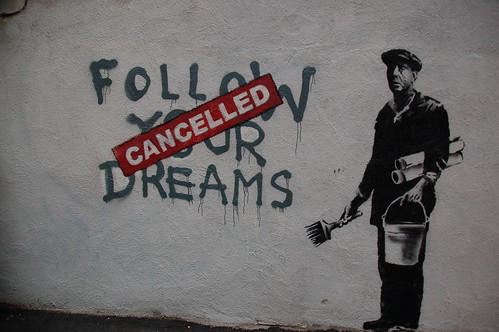
Banksy in Boston: F̶O̶L̶L̶O̶W̶ ̶Y̶O̶U̶R̶ ̶D̶R̶E̶A̶M̶S̶ CANCELLED, Essex St, Chinatown, BostonOne of the most rude and unforgivable things that you can do to another human being is be kind to it.

Picture waking up every morning, going about your business and walking past people who are hitting their heads against walls. That’s all they do. Clearly, it’s not good for them. And every day you see it – and you see a lot of people doing it, as you head yourself to your particular wall to hit your head against.

If you ever make the mistake of trying to stop them, you will be accused of being rude, some will get angry with you – you’ll even be told to mind your own business. You might make it your life’s work to go around and stop these people from hitting their heads on walls, and in doing so you’ll find yourself to be a public enemy.

You’d be a horrible person, some might say. Some might say that you don’t understand, that they need to hit their heads on walls to… achieve something that, if they get it, they won’t be able to truly appreciate because of their brain damage.

So instead of hitting your head on the wall of stopping people from hitting their heads on their walls… You learn to walk by, to leave them alone. Even the ones you like. You’ll greet them, they’ll greet you…

And maybe a few of them will say one day, “Why isn’t his head bleeding?”

You just can’t teach some things.

Some things have to be learned the hard way, and handing out helmets simply delays that.

The Walls

The walls guide our path,
The walls guide us –
Little solace in the windows
When we are seeking the door
And sometimes, a mirage appears
Our need creates our illusion.

We try to open the door, to fight our fate
Trying to put an end to the debate
The fight was good but the walls have won
The battle is over, the war never done
Eyes closed with consternation
Hiding our eyes from
Accidental reflections.

The walls guide our path,
The walls guide us –
Little solace in the windows
When we are seeking the door
And sometimes, a mirage appears
Our need creates our illusion.

We try to open the door, to fight our fate
Trying to put an end to any debate
The fight was good but the walls have won
The battle is over, the war never done
Eyes closed with consternation
We shield ourselves from
Accidental reflections.

Written in the 1990s.